Lobularia maritima (Brassicaceae)
Català
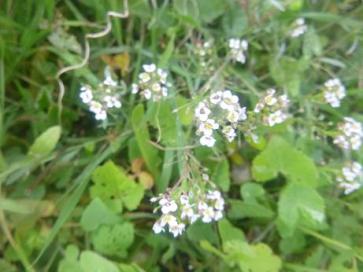
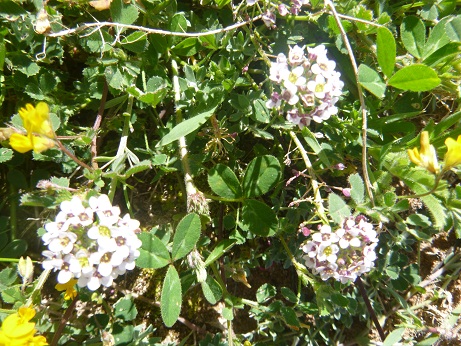
Aquesta planta, en català caps blancs, morrisà bord i uns quants altres noms locals, és originària del Mediterrani occidental i s’ha introduït en altres regions. Per exemple a Europa central on és una planta de jardí, s’ha naturalitzat com a neòfit. Al Mediterrani és perenne (camèfit), a Europa central pot arribar a ésser anual.
A les Pitiüses és molt freqüent a les voreres de camins. Floreix durant tot l’any.
Castellano
Esta planta, el aliso de mar, es originaria del Mediterráneo occidental y fue introducida en otras regiones. Por ejemplo en Europa central donde es una planta de jardín, se ha naturalizado como neófito. En el Mediterráneo es perenne (caméfito), en Europa central puede llegar a ser anual.
En las Pitiusas es muy frecuente a los bordes de caminos. Florece durante todo el año.
Deutsch
Diese Pflanze, das Strand-Silberkraut, ist im westlichen Mittelmeergebiet heimisch und wurde in anderen Gegenden eingeführt. Beispielsweise in Mitteleuropa, wo sie eine Gartenpflanze ist, hat sie sich als Neophyt ausgewildert. Im Mittelmeergebiet ist sie mehrjährig (Chamaephyt), in Mitteleuropa kann sie einjährig sein.
Auf den Pityusen ist sie an Wegrändern sehr häufig. Sie blüht das ganze Jahr hindurch.
English
This plant, the sweet alyssum, is native to the Western Mediterranean and was introduced to other regions. For example in Central Europe, where it is a garden plant, it has escaped into the wild as a neophyte. In the Mediterranean it is perennial (chamaephyte), in Central Europe it can be annual.
On the Pityuses it is very frequent at the edges of tracks. It flowers all year round.
Nom / Nombre / Name
Lobularia maritima Desv.